


The ‘New Cold War’ continues to mark urgency for organisations to bolster cyber-resilience

It’s no secret that the consequences of the Russia-Ukraine war are widespread, impacting the world in ways no one could have foreseen. As the tension continues, organisations have noticed a sharp increase in cyber-attacks. According to Bridewell Consulting’s research, 86% of organisations have reported an increased number of cyber-attacks since the start of the Ukraine war and 69% worry their systems are vulnerable to attack. With sustained attacks including DDoS, new data wipers, phishing campaigns and malware on government organisations, businesses across the globe are in danger of being caught in the cyber-crossfire.

The cyber threats are particularly concerning for critical infrastructure where IT and OT/ICS are highly interconnected. In these circumstances, a compromise may have a domino effect leading to potentially devastating consequences. While nation-state hackers may display a sense of focus and restraint, an ad-hoc army of freelance hackers is more unpredictable, leading to new vulnerabilities for both people and businesses. This surge in cyber-attacks creates a unique sense of vulnerability for businesses. With heightened cyber-risks, there is an urgent need for organisations to become cyber-resilient. The Government department for Digital, Culture, Media & Sport (DCMS), along with Julia Lopez MP has urged businesses and charities to strengthen their cyber security practices now. This comes at a time when the National Cyber Security Centre has published guidance on the steps organisations can take when the cyber threat is heightened. It’s imperative for businesses to focus their attention on their cyber security efforts, starting with what has failed in the past and seeking solutions to address these failures. This will allow businesses to learn from previous mistakes and take ownership of their own network security, or risk being collateral damage in the cyber crossfire. Aligning digital transformation with cyber-resilience Many businesses fast-tracked their approach to digital transformation during the Covid-19 pandemic. As such, organisations were forced to ease security procedures to help staff adjust to remote working, creating a variety of security issues. The emerging all-digital lifestyle and work-from-home environment will continue to complicate cyber security and give criminals new vulnerabilities to attack. In Deloitte’s recent article on the impact of Covid-19 on cyber security, it highlights a Swissinfo.ch report of figures from the NCSC (National Cyber Security Center) for June 2020. These figures indicated individuals working at home do not have the same level of inherent protection/deterrent measures compared to an office working environment. Reimagining traditional password security The main reason criminals easily gain access and command over a network is due to the inherent weaknesses apparent in the traditional approach to network security. In the office workspace, organisations distribute passwords to their employees directly, rather than having an employee craft a key themselves. The power lies in the hands of the business, rather than the individual. But when companies went digital, they flipped that process around. Suddenly, they let their employees create their own keys to every system, transferring ownership and control of access to them. From that moment, organisations no longer knew or had control over when, where, and how employees would share, lose, or reuse passwords. The ability for employees to share, lose, and reuse their passwords without their organisation knowing, leads to tactics such as phishing, social engineering, credentials stuffing and password spraying to allow cyber criminals to get past unsuspecting users. Cyber criminal’s access points Loosening the security rules and regulations on staff to support remote work continues to cause several security issues. For instance, it has proven to be problematic to blindly give untrained staff permission to connect their personal devices to the enterprise network or use employer-supplied computers for personal use. Doing so can create various problems, even something as simple as clicking on a phishing link within a personal email, can cause enormous disruption, if only to the work flow of the IT team tasked with resolving the issue. The problem is compounded as employees increase the chances of a threat through their personal Wi-Fi networks that have no security policies in place. Once connected they’re often using a VPN, granting open-ended authorisations to access entire suites of corporate files and data, without background verification checks or security reviews. Regain control of your network, before it’s too late Businesses should invest to secure their networks. They should adopt a high-bandwidth network infrastructure, upgrade security protocols, establish internal policies giving guidelines on how employees should protect company data and information, and improve password protection by enforcing multifactor authentication. Faced with the increased risk of getting caught in the cyber crossfire, it is not too late for organisations to take responsibility for the security of their networks and make their digital infrastructure cyber-resilient.
You may be interested in
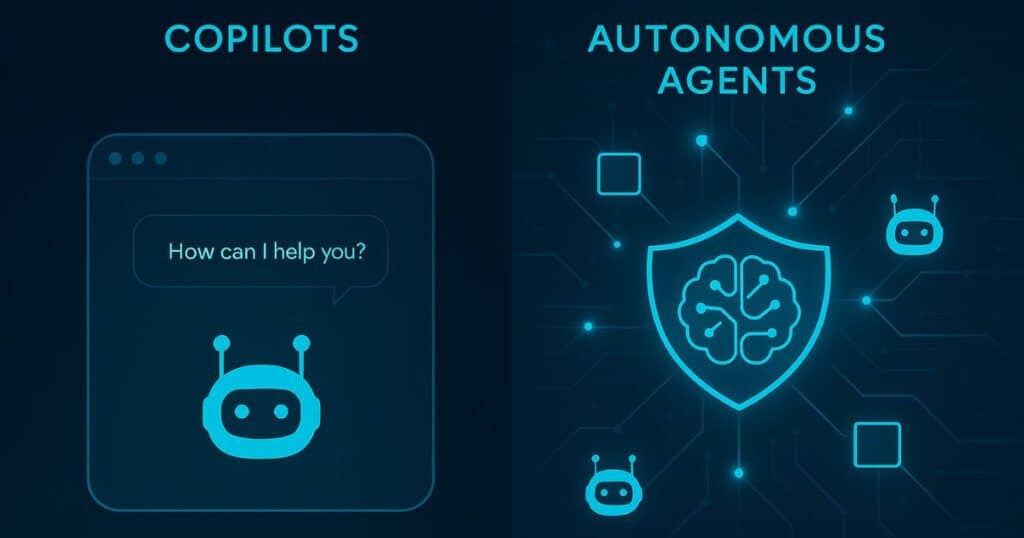
Beyond Copilots: Why AI Agents Are the Next Competitive Advantage
AI is no longer a tactical tool, it’s becoming the engine of enterprise transformation. While copilots and other generative AI tools have helped teams work faster, the real breakthrough is happening with AI agents: autonomous systems that don’t just assist but act, learn and orchestrate entire workflows across the business. The question every executive should be asking is: “How will we harness AI to create value at scale before our competitors do?” High-performing organisations aren’t waiting. They’re embedding AI agents into daily operations and seeing measurable impact; accelerated decision-making, leaner processes and stronger financial outcomes. When markets move at digital speed, standing still means falling behind. Here’s why: So, the question isn’t “Should we adopt AI?”, it’s “What could…
Zero Trust Networking
Protecting Employees Without Friction Your workforce is your greatest asset, and your greatest vulnerability. Attackers know this, which is why phishing and credential theft remain the most common entry points. But here’s the leadership challenge: how do you protect employees without slowing them down? Zero Trust answers that question by making security invisible yet uncompromising. Employees work from anywhere, home, client sites, airports, without clunky VPNs or endless password resets. Behind the scenes, every login is verified, every device assessed, every anomaly flagged. If something looks wrong, a compromised credential, an unusual location, the system reacts…
Shadow AI: Executive Briefing on Real Risks, Business Impact and Mitigation
Shadow AI is here, and it’s growing Shadow AI is the use of artificial intelligence tools and platforms outside the oversight of IT, security, or compliance teams. This is not a hypothetical concern. KPMG’s 2025 global survey found that up to 58% of employees are using AI productivity tools daily, and nearly half admit to uploading sensitive company information to unauthorised platforms. Only 41% of employees say their organisation has a policy guiding the use of generative AI, revealing a significant governance gap. The Risks Are Real and Substantial The evidence from leading analysts and recent incidents is clear:…
Cyber Resilience in 2025: From Tick-Box to Boardroom Imperative
What the NCSC’s 2025 Review Means for UK Businesses The National Cyber Security Centre’s (NCSC) 2025 Annual Review is a wake-up call for business leaders across the UK. The days when cyber security was simply an IT concern or a routine compliance task are over. With a record number of nationally significant cyber incidents handled in the past year (more than double the previous year’s figure), it is clear that cyber risks have become a central issue for organisational survival and national prosperity. The Evolving Threat: Why Businesses Can’t Afford Complacency No sector has been spared in the latest…

Is Your MSP Really Helping You Grow — Or Just Keeping the Lights On?
There’s a moment in every business where the question quietly surfaces: “Are we getting what we really need from our IT provider?” It’s not always easy to answer. On the surface, things seem fine. Tickets are resolved. Reports arrive. There’s someone to call when things go wrong. It’s familiar. It’s comfortable. And that comfort can be deceiving. Because beneath the surface, many organisations are stuck in a service relationship that feels safe — but is actually stagnant. And here’s the truth: comfort isn’t the same as progress. For many, the idea of changing MSPs or challenging the…
The 2025 State of Ransomware: Key Insights on Attacks, Costs, and Recovery
Ransomware continues to evolve — and so must our defenses. The State of Ransomware 2025 report from Sophos presents one of the most comprehensive views yet into how organisations around the world are being impacted by ransomware attacks. Based on an independent survey of 3,400 IT and cybersecurity leaders across 17 countries, the report explores how attacks are evolving, the operational weaknesses adversaries exploit, and the human and financial tolls that follow. Whether you’re building a cybersecurity strategy or assessing risk, this year’s findings offer crucial, real-world insights to guide your response. Key Findings from…