


Cloud Communications benefits your customer service teams

Whilst CRM’s (Customer Relationship Management software), live chat and help desk solutions all contribute to a positive customer experience, these separate systems and technologies can equally create unnecessary barriers and potentially harm the relationship you have with your customers.
It’s exceedingly important therefore to connect these siloed applications to create more seamless operations so that your customer service experience is improved and taken to the next level and that’s where cloud communications can support you.
Amalgamating video chat, audio and mobile capabilities, Unified Communications can be utilised from any location therefore supporting the hybrid working model for your customer services, supporting more productive work from your teams as they can handle calls wherever they are. Unified Comms allows you to connect with all parts of your business and all of this culminates ultimately in a great experience for all your customers.
Customers are more intuitive and demanding now than they ever have been. They expect excellent customer service (and rightly so!), desiring live chat and real time communications.
The Key Components of Unified Communications
VoIP
The flexibility of the cloud supports use of all your devices to make and receive calls using the web, a server, and a phone. The user-friendly application is supported by the web, allowing full administrative rights to manage calls and monitor call performance. This is far more convenient than any phone line and is far more convenient to use.
VoIP-Voice over the internet protocol, supports digital information to travel through the internet rather than traditional phone lines. This not only significantly reduces your cost, but it also means that your teams can make multiple phone calls wherever they are, as long as they have an internet connection.
Messaging
Messaging features were typically a separate feature from most solutions; however, Cloud Communications has integrated this feature allowing it to be more dynamic. Users are able to manage multiple chats and switch between different elements of cloud communication as and when needed. Not only does this support internal team comms, but also means that your customers can enjoy any mode of conversation utilising SMS, phone call, Twitter DM, or Facebook messenger.
Sharing files
This is imperative in modern business and one that remote and hybrid working has hindered. Being able to simultaneously work on multiple tasks, complete projects and communicating with multiple people is supported in unified communications regardless of the locations of your teams. This creates the seamless operations you need for your customers.
Sharing screens
We’ve all probably got use to this haven’t we over the last few years, well Unified Comms supports file sharing, meaning you can see each other’s emails, spreadsheets, photos or files-whatever is on their screen, in real time considerably increasing collaboration and improving the time on decision making.
Video Conferencing
As the pandemic hit, we all got used to this function and this is certainly a feature of unified communications. Your remote teams can join conferences via laptop, tablet, or smartphone wherever they are without any disruption to themselves, your business, or your customers.
Presence
This is an incredibly valuable feature. With presence you are able to see who’s available, who’s offline, busy, out of the office. It can be used on desktop, mobile, and UC and this enables a far more seamless approach to your customer services. This function is provided by SIP (Session Initiation Protocol) and with this feature, you can see who you can utilise at that given moment to support your customers.
Cloud Communications is supporting businesses to transition to far more modern working practises (particularly for the hybrid working environment) to create the seamless, productive operations that businesses need.
By supporting your teams with these multiple tools, means not only your teams will feel supported in their working practises, but ultimately, your customers experience will be a positive one.

Subsribe for updates and our latest research
You may be interested in
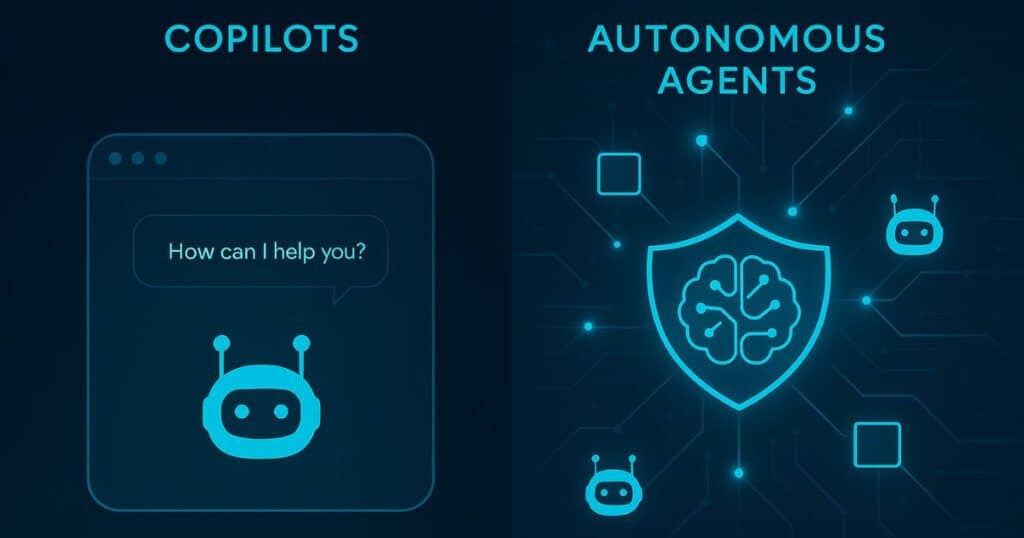
Beyond Copilots: Why AI Agents Are the Next Competitive Advantage
AI is no longer a tactical tool, it’s becoming the engine of enterprise transformation. While copilots and other generative AI tools have helped teams work faster, the real breakthrough is happening with AI agents: autonomous systems that don’t just assist but act, learn and orchestrate entire workflows across the business. The question every executive should be asking is: “How will we harness AI to create value at scale before our competitors do?” High-performing organisations aren’t waiting. They’re embedding AI agents into daily operations and seeing measurable impact; accelerated decision-making, leaner processes and stronger financial outcomes. When markets move at digital speed, standing still means falling behind. Here’s why: So, the question isn’t “Should we adopt AI?”, it’s “What could…

Zero Trust Networking
Protecting Employees Without Friction Your workforce is your greatest asset, and your greatest vulnerability. Attackers know this, which is why phishing and credential theft remain the most common entry points. But here’s the leadership challenge: how do you protect employees without slowing them down? Zero Trust answers that question by making security invisible yet uncompromising. Employees work from anywhere, home, client sites, airports, without clunky VPNs or endless password resets. Behind the scenes, every login is verified, every device assessed, every anomaly flagged. If something looks wrong, a compromised credential, an unusual location, the system reacts…
Shadow AI: Executive Briefing on Real Risks, Business Impact and Mitigation
Shadow AI is here, and it’s growing Shadow AI is the use of artificial intelligence tools and platforms outside the oversight of IT, security, or compliance teams. This is not a hypothetical concern. KPMG’s 2025 global survey found that up to 58% of employees are using AI productivity tools daily, and nearly half admit to uploading sensitive company information to unauthorised platforms. Only 41% of employees say their organisation has a policy guiding the use of generative AI, revealing a significant governance gap. The Risks Are Real and Substantial The evidence from leading analysts and recent incidents is clear:…

Cyber Resilience in 2025: From Tick-Box to Boardroom Imperative
What the NCSC’s 2025 Review Means for UK Businesses The National Cyber Security Centre’s (NCSC) 2025 Annual Review is a wake-up call for business leaders across the UK. The days when cyber security was simply an IT concern or a routine compliance task are over. With a record number of nationally significant cyber incidents handled in the past year (more than double the previous year’s figure), it is clear that cyber risks have become a central issue for organisational survival and national prosperity. The Evolving Threat: Why Businesses Can’t Afford Complacency No sector has been spared in the latest…

Is Your MSP Really Helping You Grow — Or Just Keeping the Lights On?
There’s a moment in every business where the question quietly surfaces: “Are we getting what we really need from our IT provider?” It’s not always easy to answer. On the surface, things seem fine. Tickets are resolved. Reports arrive. There’s someone to call when things go wrong. It’s familiar. It’s comfortable. And that comfort can be deceiving. Because beneath the surface, many organisations are stuck in a service relationship that feels safe — but is actually stagnant. And here’s the truth: comfort isn’t the same as progress. For many, the idea of changing MSPs or challenging the…
The 2025 State of Ransomware: Key Insights on Attacks, Costs, and Recovery
Ransomware continues to evolve — and so must our defenses. The State of Ransomware 2025 report from Sophos presents one of the most comprehensive views yet into how organisations around the world are being impacted by ransomware attacks. Based on an independent survey of 3,400 IT and cybersecurity leaders across 17 countries, the report explores how attacks are evolving, the operational weaknesses adversaries exploit, and the human and financial tolls that follow. Whether you’re building a cybersecurity strategy or assessing risk, this year’s findings offer crucial, real-world insights to guide your response. Key Findings from…