


Emperor – Enriching business with advanced remote production

Emperor is one of the UK’s leading employee-owned creative agencies. It specialises in reporting, brand, employee experience, and sustainability and is an expert in getting the most from integrated media and channels. Through this knowledge, Emperor enables its clients, including blue-chip brands such as BP, BT, Reckitt Benckiser, and the London Stock Exchange, to deliver better business. Emperor employs over 200 people across a national and international network in London, Edinburgh, Manchester, Warwick and Dubai.
Introduction

As part of a broader and ongoing strategy to streamline and optimise its services and internal workflows, Emperor investigated migrating its core on-premise production servers to the cloud. The global pandemic accelerated this strategy leading the agency to seek a robust, secure, and super-fast cloud NAS. The pandemic panicked many companies into committing to temporary sub-optimal solutions, but Emperor had had the foresight to prepare. “While we couldn’t have predicted anything like the impact of a pandemic, we had begun the process of moving to a more agile, cost-effective and time-efficient working environment in the cloud,” explains Noel O’Connor, Emperor Founder & Creative Director. “We ran standalone servers in our office locations, and while we could connect to them, we knew we needed something faster for the long term.” “Before Covid, we had looked into Microsoft Azure but found the user experience was not a lot different to what we were doing with our Virtual Private Network (VPN), so we shelved the idea,” O’Connor says. “When the pandemic hit, we moved to work from home and continued using the VPN while raising the search for an easy-to-use, high-speed, cloud-based server to the top of the agenda.”
Business challenge
Pre-pandemic, the challenge facing Emperor was to find a faster, seamless solution for access to files across its national and international hubs. With employees working remotely from home the issue was exacerbated. “We had access to our data, but it could be unacceptably slow, which made it very difficult to perform some tasks,” O’Connor explains. “Our team had to download media locally to work on them efficiently. That’s fine if it’s a word document, but invariably we are exchanging files of several gigs worth of data.” For the design and publication of marketing and communications materials and annual financial reports, Emperor works predominantly in the Adobe Creative Cloud Suite and, in particular, with large InDesign files. Creating a PDF from InDesign files comprised of multiple high-resolution, high-colour fidelity JPEG, TIFF, PNG, and other graphics formats with links typically involves several gigabits of data. Sharing this core asset over VPN either internally or for client review and approval proved very challenging. “To create a PDF proof, you have to have all the links accessible, and doing this over VPN was extremely painful,” O’Connor explained. “VPN is really dependent on the available broadband connection, which varies across our teams and can be compromised when working from home by other users sharing the connection.” The company had a very structured and disciplined set of processes for the studio operation. This was designed to support project teams of half a dozen or more members with access to the same set of assets regardless of whether they were in the UK or in a different time zone. “Unanimously, we thought LucidLink was really fast and something we could benefit from,” O’Connor said.
Situation post-move
“When we moved out of the office, we did so overnight. As well as setting up numerous VPN connections, we also set up workstations on-site that were connected to our network, allowing users to remote into our studio environment and carry out certain workflows as if they were in the office. This solution undoubtedly helped but was still clunky and cumbersome for users.”  The team was also acutely conscious of the potential for file and version management issues and implemented systems and procedures to avoid this as specific files and images had to be worked on locally. “We operate out of 5 studios – which at the time was effectively 230 studios,” O’Connor illustrates, “as we were all working from home and had to maintain a tight regime to ensure the integrity of our data and backups. “For all these reasons, we needed an overhaul of our basic connectivity,” O’Connor says. “But that seems like a long time ago. It’s amazing how fast you adapt to change, and the team is working so fluently on LucidLink now it’s as if they’ve forgotten how frustrating and time-consuming life was before.”
Solution
Emperor tasked its IT partner Espria with finding this solution. “Espria presented several concepts to us. LucidLink immediately stood out and gave us an edge on what we already had.” O’Connor and his team dived into further research. “We sat in on webinars where Adobe demonstrated collaborative tools for media, and we set up some test accounts internally and tested, and tested, and tested it.”

Results
Installed and in use since autumn 2020, Espria migrated virtually all of Emperor’s desktop publishing applications and practices to the cloud using LucidLink as the bedrock connectivity. “It took a while for us all to adapt to working remotely but it took almost no time at all to get up and running with LucidLink,” O’Connor says. “In particular, we needed a solution to work with Adobe InDesign. With our previous solution, creating PDFs remotely was very challenging. The experience working with InDesign has been extremely straightforward. Espria & LucidLink’s solution is undoubtedly a better way of working and what’s most impressive is that it is incredibly fast. “All the time it was taking to manage and transport data backwards and forwards – well, all those issues have gone away. We now work directly from the cloud server. There should be no situation where people need material on their desktops. When someone else in our team picks up the job, all the assets are in the cloud – the single source of truth.” In the future, the intention is to streamline workflows further by moving to one centralised set of cloud-based folders for all live projects. Along with countless other businesses, Emperor has returned to work at the office where the future of the workspace itself has been permanently altered. O’Connor continued, “LucidLink has changed the way we can access our files. Although we all have remote capability, now the experience is like being in the office.”
Work-life balance
O’Connor says, “We returned to the office at the beginning of summer 2021, with a hybrid’ hub and spoke’ model. We continue lean on the remote working technology and infrastructure from Espria and LucidLink to give us far greater flexibility in terms of how we work as a team and how we liaise with clients.” For all the frustration and anxiety of the enforced working from home period, it has also proven the benefits of technology in allowing a more balanced working life. He adds, “There are definitely some of our team who prefer not to commute every day, who can be just as, if not more, productive at home as in the office and who can now collaborate with colleagues and clients just as seamlessly from wherever they are.”
Reveal areas that need proactive, defensive or collaborative resource
One of our experts will review your current data risk, examine current governance and security controls.
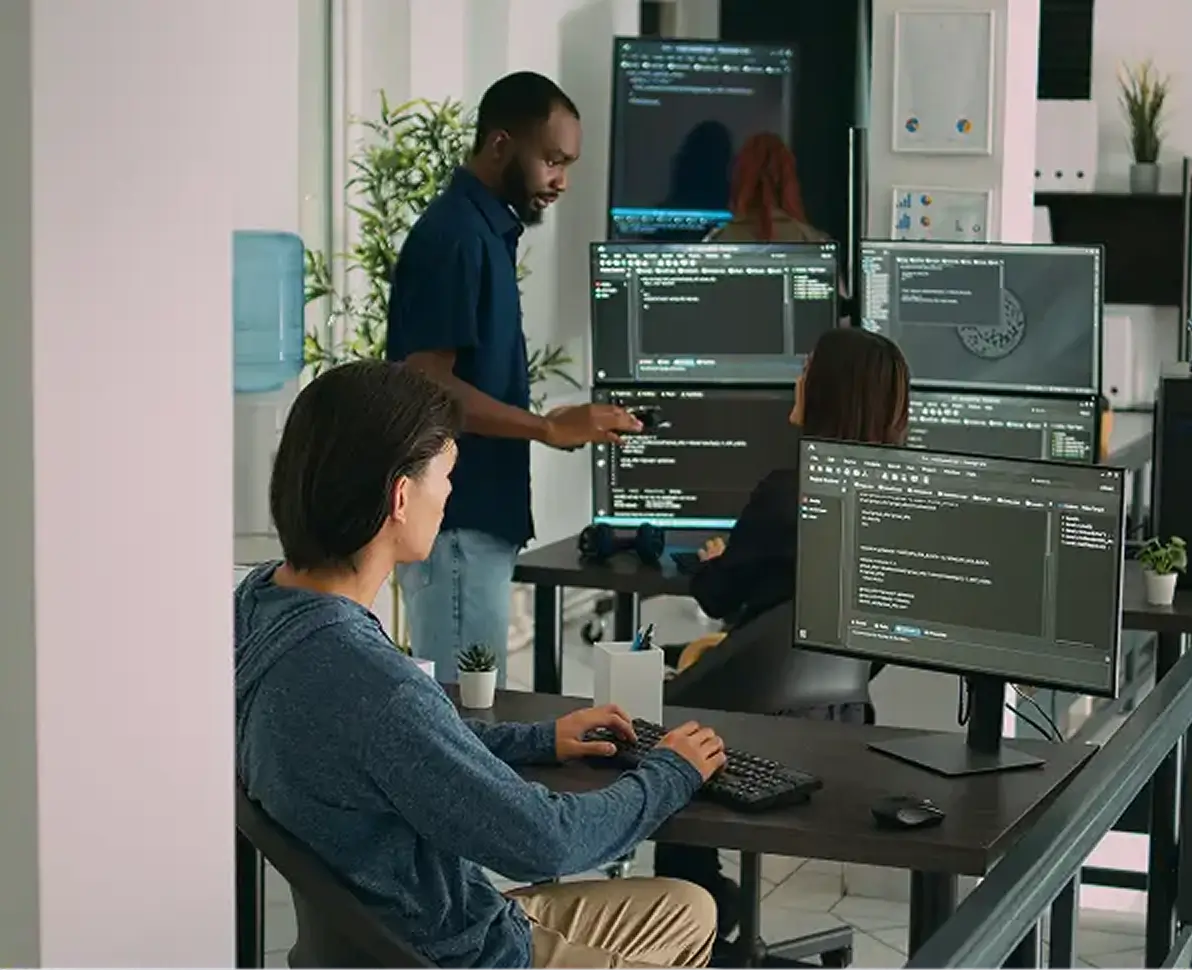

We’re experts in building sustainable IT infrastructure that can scale to your businesses needs.
You may be interested in
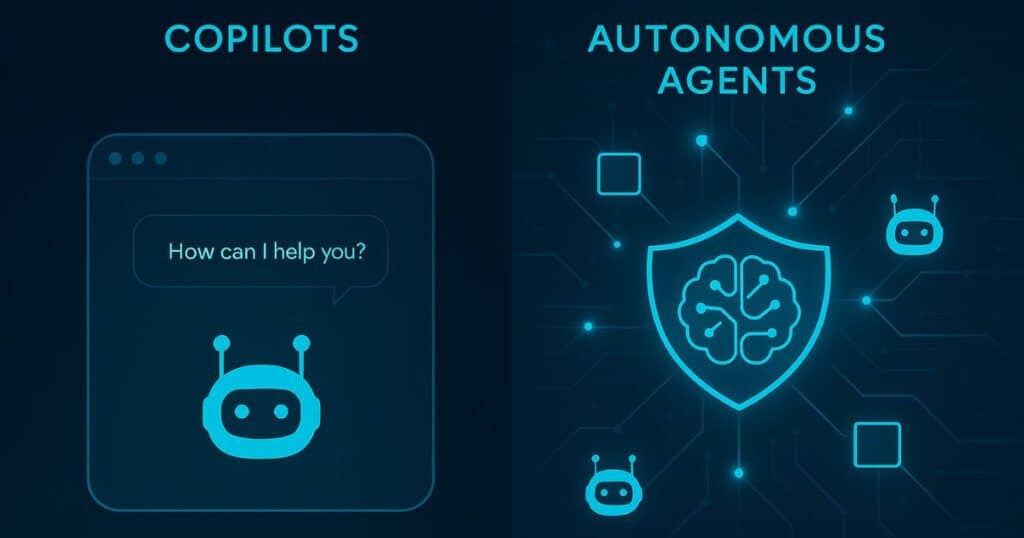
Beyond Copilots: Why AI Agents Are the Next Competitive Advantage
AI is no longer a tactical tool, it’s becoming the engine of enterprise transformation. While copilots and other generative AI tools have helped teams work faster, the real breakthrough is happening with AI agents: autonomous systems that don’t just assist but act, learn and orchestrate entire workflows across the business. The question every executive should be asking is: “How will we harness AI to create value at scale before our competitors do?” High-performing organisations aren’t waiting. They’re embedding AI agents into daily operations and seeing measurable impact; accelerated decision-making, leaner processes and stronger financial outcomes. When markets move at digital speed, standing still means falling behind. Here’s why: So, the question isn’t “Should we adopt AI?”, it’s “What could…
Zero Trust Networking
Protecting Employees Without Friction Your workforce is your greatest asset, and your greatest vulnerability. Attackers know this, which is why phishing and credential theft remain the most common entry points. But here’s the leadership challenge: how do you protect employees without slowing them down? Zero Trust answers that question by making security invisible yet uncompromising. Employees work from anywhere, home, client sites, airports, without clunky VPNs or endless password resets. Behind the scenes, every login is verified, every device assessed, every anomaly flagged. If something looks wrong, a compromised credential, an unusual location, the system reacts…
Shadow AI: Executive Briefing on Real Risks, Business Impact and Mitigation
Shadow AI is here, and it’s growing Shadow AI is the use of artificial intelligence tools and platforms outside the oversight of IT, security, or compliance teams. This is not a hypothetical concern. KPMG’s 2025 global survey found that up to 58% of employees are using AI productivity tools daily, and nearly half admit to uploading sensitive company information to unauthorised platforms. Only 41% of employees say their organisation has a policy guiding the use of generative AI, revealing a significant governance gap. The Risks Are Real and Substantial The evidence from leading analysts and recent incidents is clear:…

Cyber Resilience in 2025: From Tick-Box to Boardroom Imperative
What the NCSC’s 2025 Review Means for UK Businesses The National Cyber Security Centre’s (NCSC) 2025 Annual Review is a wake-up call for business leaders across the UK. The days when cyber security was simply an IT concern or a routine compliance task are over. With a record number of nationally significant cyber incidents handled in the past year (more than double the previous year’s figure), it is clear that cyber risks have become a central issue for organisational survival and national prosperity. The Evolving Threat: Why Businesses Can’t Afford Complacency No sector has been spared in the latest…

Is Your MSP Really Helping You Grow — Or Just Keeping the Lights On?
There’s a moment in every business where the question quietly surfaces: “Are we getting what we really need from our IT provider?” It’s not always easy to answer. On the surface, things seem fine. Tickets are resolved. Reports arrive. There’s someone to call when things go wrong. It’s familiar. It’s comfortable. And that comfort can be deceiving. Because beneath the surface, many organisations are stuck in a service relationship that feels safe — but is actually stagnant. And here’s the truth: comfort isn’t the same as progress. For many, the idea of changing MSPs or challenging the…
The 2025 State of Ransomware: Key Insights on Attacks, Costs, and Recovery
Ransomware continues to evolve — and so must our defenses. The State of Ransomware 2025 report from Sophos presents one of the most comprehensive views yet into how organisations around the world are being impacted by ransomware attacks. Based on an independent survey of 3,400 IT and cybersecurity leaders across 17 countries, the report explores how attacks are evolving, the operational weaknesses adversaries exploit, and the human and financial tolls that follow. Whether you’re building a cybersecurity strategy or assessing risk, this year’s findings offer crucial, real-world insights to guide your response. Key Findings from…