


Why Robotic Process Automation (RPA) and GenAI revolutionise SME operations
In the past year alone, industry has seen rapid and revolutionary transformations due to advancements in automation. Organisations have been able to reduce the time spent on repetitive tasks such data manipulation, migration, entry and analysis, and also those spent remediating human error, saving their resources for more critical tasks. Simply getting up to speed with automation can offer huge benefits to business functions like HR, finance, travel and marketing – all supporting business efficiency and ultimately, profitability.
In previous years, the rise of Robotic Process Automation (RPA) has removed the burden that legacy technologies, cumbersome manual processes and repetitive tasks had on day-to-day business operations. By offering companies of any size the potential for low-cost, accessible ways to understand data, they can benefit from faster, more informed decision-making. With the current explosion in Generative AI solutions, we are sure to see operations bolstered once more. But how can SMEs be convinced to make another radical change to their operations without fear?
Here are 4 reasons why RPA and GenAI aren’t a threat to operations, but rather have the power to completely transform SMEs for the better:
Low-cost investments for rapid results
Previously, automation solutions have often required both software and hardware, as well as an investment in training current staff members. In some cases, such as when employees are not able or willing to learn, SMEs have also had to invest in recruiting new staff with the necessary digital skills to work with the new technologies.
RPA is now available as a SaaS (software-as-a-service) offering, meaning businesses of any size can access it through a simple cloud deployment. RPA SaaS is also an affordable option, particularly for smaller companies, avoiding the cost implications of investing in expensive infrastructure or re-architecting applications.
Businesses also have the opportunity to remove the weight that legacy technologies, burdensome manual processes and repetitive tasks place on their everyday operations. By automating repetitive tasks with improved accuracy and efficiency, businesses are able to invest more time in retraining and reskilling workers in different, more productive areas.
AI-supported humans will become the new workforce
Whenever a new, disruptive technology emerges, there is always an underlying concern that humans with be replaced. However, SMEs shouldn’t be scared: as RPA only replaces those roles that can’t be fulfilled by humans, the same is true of Generative AI tools; either because humans cannot be found to perform the roles, or the level of quality needed cannot be consistently delivered by the human hand.
If anything, adopting AI tools will allow staff to spend more time being innovative and getting in touch with their creative side, which opens the opportunity for increased personal development and the chance to be re-deployed to higher-level, managerial roles. Rather than replace the roles, the tools simply offer different avenues and the creation of new technical roles, where skilled workers are now needed to monitor and analyse the results.
Tools like ChatGPT are simply that – tools. They shouldn’t be demonised, as they simply enable another interface into the digital world, aiding workers in finding answers. As it matures, it will only become riper for creativity, and therefore business opportunity.
AI and automation tools are accessible across sectors
Whilst the early adopters of RPA were larger enterprises in the finance and banking sectors, automation tools have had huge success in revolutionising sectors such as healthcare, manufacturing and logistics. RPA can be used to automate most repetitive tasks in many different organisations across an array of industries – for greater accuracy and efficiency.
These necessary tasks crosscut every industry, which highlights how RPA can be of great assistance in improving how businesses run, regardless of the sector.
As AI becomes more reliable as an operational enhancement mechanism, Generative AI tools will only become more accessible. Whilst some have concerns about ChatGPT and similar tools marking the end of creativity, a more realistic and grounded approach will be how generative AI will enhance information gathering and collection – medial tasks applicable across all sectors. As it matures, the level of content will improve and become more efficient for specific sector and industry needs.
Embracing new avenues for operational improvement
Whilst the current focus of RPA and GenAI providers is firmly placed on bigger enterprises, particularly banks and financial services firms, engagement with SMEs could be more impactful due to their smaller size and therefore greater business agility. Yet many SMEs are not currently geared towards optimising the technology they have, let alone the adoption of automation and AI-related systems, which means they may not immediately appreciate the value it can bring to their business. Add to this the fact that many RPA providers focus most of their time and resources on the “big boys”, how can SMEs be aware of the impact that automation technologies could have on day-to-day operations and their bottom line?
Business leaders in SMEs, particularly those with purchasing power, must take the lead and push for new technologies to be introduced into their company workflows. They should look to engage with the right partners and cloud providers who have knowledge of the most cost-effective and accessible solutions, now be provided as SaaS.
For businesses, finding a trusted external technology partner which can fill a company’s skills and expertise gaps is essential at a time of economic downturn. Managed Service Providers (MSPs) need to act as business partners, helping assess your risk exposure, develop security policies, choose and deploy security solutions, ensure compliance with regulatory mandates for data protection and develop skills with your teams.
As in any period of economic uncertainty, businesses need to control and contain cost. MSPs in turn need to adapt and evolve with technology in order to offer clients in turn the most comprehensive solutions possible, and bring real value-add. If SMEs partner with the right MSP they can get started in a very low-cost, low risk manner, and reap the full rewards of RPA and GenAI.

To read more about our Modern Workplace solutions, please click here.
You may be interested in
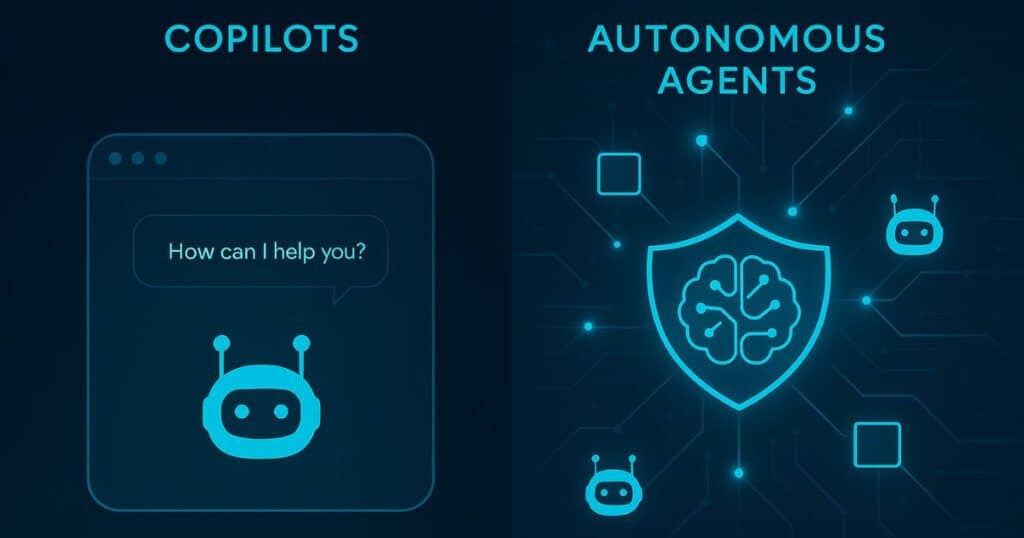
Beyond Copilots: Why AI Agents Are the Next Competitive Advantage
AI is no longer a tactical tool, it’s becoming the engine of enterprise transformation. While copilots and other generative AI tools have helped teams work faster, the real breakthrough is happening with AI agents: autonomous systems that don’t just assist but act, learn and orchestrate entire workflows across the business. The question every executive should be asking is: “How will we harness AI to create value at scale before our competitors do?” High-performing organisations aren’t waiting. They’re embedding AI agents into daily operations and seeing measurable impact; accelerated decision-making, leaner processes and stronger financial outcomes. When markets move at digital speed, standing still means falling behind. Here’s why: So, the question isn’t “Should we adopt AI?”, it’s “What could…

Zero Trust Networking
Protecting Employees Without Friction Your workforce is your greatest asset, and your greatest vulnerability. Attackers know this, which is why phishing and credential theft remain the most common entry points. But here’s the leadership challenge: how do you protect employees without slowing them down? Zero Trust answers that question by making security invisible yet uncompromising. Employees work from anywhere, home, client sites, airports, without clunky VPNs or endless password resets. Behind the scenes, every login is verified, every device assessed, every anomaly flagged. If something looks wrong, a compromised credential, an unusual location, the system reacts…
Shadow AI: Executive Briefing on Real Risks, Business Impact and Mitigation
Shadow AI is here, and it’s growing Shadow AI is the use of artificial intelligence tools and platforms outside the oversight of IT, security, or compliance teams. This is not a hypothetical concern. KPMG’s 2025 global survey found that up to 58% of employees are using AI productivity tools daily, and nearly half admit to uploading sensitive company information to unauthorised platforms. Only 41% of employees say their organisation has a policy guiding the use of generative AI, revealing a significant governance gap. The Risks Are Real and Substantial The evidence from leading analysts and recent incidents is clear:…

Cyber Resilience in 2025: From Tick-Box to Boardroom Imperative
What the NCSC’s 2025 Review Means for UK Businesses The National Cyber Security Centre’s (NCSC) 2025 Annual Review is a wake-up call for business leaders across the UK. The days when cyber security was simply an IT concern or a routine compliance task are over. With a record number of nationally significant cyber incidents handled in the past year (more than double the previous year’s figure), it is clear that cyber risks have become a central issue for organisational survival and national prosperity. The Evolving Threat: Why Businesses Can’t Afford Complacency No sector has been spared in the latest…

Is Your MSP Really Helping You Grow — Or Just Keeping the Lights On?
There’s a moment in every business where the question quietly surfaces: “Are we getting what we really need from our IT provider?” It’s not always easy to answer. On the surface, things seem fine. Tickets are resolved. Reports arrive. There’s someone to call when things go wrong. It’s familiar. It’s comfortable. And that comfort can be deceiving. Because beneath the surface, many organisations are stuck in a service relationship that feels safe — but is actually stagnant. And here’s the truth: comfort isn’t the same as progress. For many, the idea of changing MSPs or challenging the…
The 2025 State of Ransomware: Key Insights on Attacks, Costs, and Recovery
Ransomware continues to evolve — and so must our defenses. The State of Ransomware 2025 report from Sophos presents one of the most comprehensive views yet into how organisations around the world are being impacted by ransomware attacks. Based on an independent survey of 3,400 IT and cybersecurity leaders across 17 countries, the report explores how attacks are evolving, the operational weaknesses adversaries exploit, and the human and financial tolls that follow. Whether you’re building a cybersecurity strategy or assessing risk, this year’s findings offer crucial, real-world insights to guide your response. Key Findings from…