


Is UK Broadband Ready For Hybrid Working?

Hotspots and Notspots: Is UK broadband infrastructure ready for hybrid working?
How good is UK broadband? Depending on where you live, your options could range from high-speed fibre to a sluggish, intermittent connection. And in today’s working world, those stuck in the latter camp could face major obstacles.
Increasingly, employees are expected to be able to work on a remote or hybrid basis. When the working day is packed with video calls, thousand-row spreadsheets and hefty file downloads, an unreliable broadband connection is a severe disadvantage. Those not blessed with adequate broadband coverage could see their productivity dented.
That’s why we set out to determine the full extent of the UK’s broadband shortcomings. We’ve analysed the data and crunched the numbers, using Ofcom’s Connected Nations dataset to construct a top-down view of the state of UK broadband. From here, we built up a regional picture of connectivity across the UK, ranking the towns with the best and worst broadband coverage. Read on to learn what we found.
Left behind by the remote revolution
Broadband speed now matters more than ever before. And at the root of it all is the COVID-19 pandemic.
Before COVID struck, nine-to-five in the office and the daily commute were non-negotiable aspects of working life for most Brits. However, successive lockdowns laid the groundwork for ‘the new normal’ and it is now standard practice for workplaces to follow a hybrid approach, with employees coming into the office a few days a week and working from home the rest of the time. Some companies have done away with the office entirely, requiring their employees to work on a fully remote basis.
To work from home effectively, you need good broadband. Yet our analysis reveals that one in four workers fall short of the 30 megabits per second (Mbps) required to keep up with the ever-increasing bandwidth demands of modern work. And while there are a few broad geographical patterns to who does and doesn’t have solid connectivity – such as Scotland and Wales on average, being worse off than England – the biggest disparities tend to be town to town, postcode to postcode.
To work from home, you need good broadband. Yet one in four workers fall short of the 30 Mbps required to keep pace with modern workloads.
Though some towns have seen big lifts in connectivity following recent regeneration projects, such as Crawley in the Southeast of England, Nuneaton in the Midlands and Blackburn in the North West, others haven’t had the same luck. Fermanagh in Northern Ireland, Brecon in mid-Wales and Stockton in the Northeast of England are examples of towns in dire need of infrastructure upgrades.
This matters for businesses just as much as it does for individuals. Businesses want access to the best applicants, regardless of location. And individuals shouldn’t have their career options limited by a poor internet connection. Yet for many within the UK, this is the sad reality.
Different sectors, Different speeds
Our research also revealed differences in the bandwidth needs of different industries.
Unsurprisingly, IT & Telecoms comes top of the list, requiring 60 Mbps on average. In second place is the data-rich sector of Financial Services, with Customer Service rounding out the top three.
At the other end of the rankings, we have the Charity & Voluntary sector, which requires just 22.5 Mbps of its average worker. Then, Project Management and Business Development come second and third last respectively.
| Sector | Speed |
|---|---|
| IT & Telecoms | 60 Mbps |
| Financial Services | 48.5 Mbps |
| Customer Service | 47.5 Mbps |
| Medical & Health | 45.5 Mbps |
| Media, Digital & Creative | 33 Mbps |
| Sales | 27.5 Mbps |
| Education & Training | 26 Mbps |
| Business & Development | 25 Mbps |
| Project Management | 23.5 Mbps |
| Charity & Voluntary | 22.5 Mbps |
If you work remotely in an industry with heavy bandwidth requirements and plan to relocate, you may wish to consider the impact of broadband speeds on your productivity and property website Rightmove, can now provide this information. How many video calls will you have to field? Do you have to transfer large files? Will you be logging into a company VPN? The number of people sharing your connection has an impact too – two people working from your home could double the demands on your bandwidth.
Despite this variability between individuals and industries, sky-high speeds are rarely essential. What matters more is that employees have access to good enough broadband that will allow them to complete their tasks without any slowdown.
Yet a considerable chunk of the UK falls short of the bandwidth needed for even the lowest ranking sectors – 7% of the population receives under 10 Mbps. This presents a real barrier to successful remote working, especially when there is no physical office to work from if speed dips even lower.
7% of the UK population receives under 10 Mbps
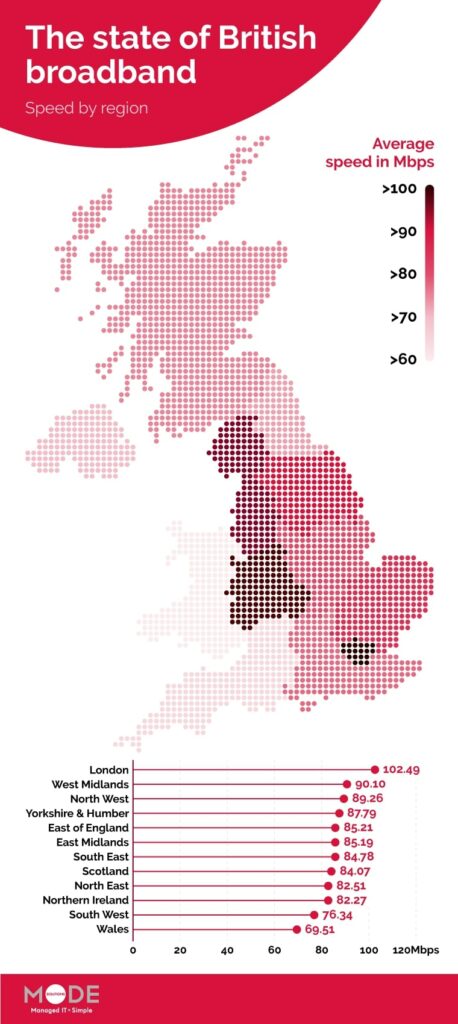
The picture that emerges from our data analysis is of the highest speeds being clustered around the South of England, with average connection speed dropping the further away you get from London. Average connection speeds in Wales are particularly poor, with the Southwest of England not far behind.
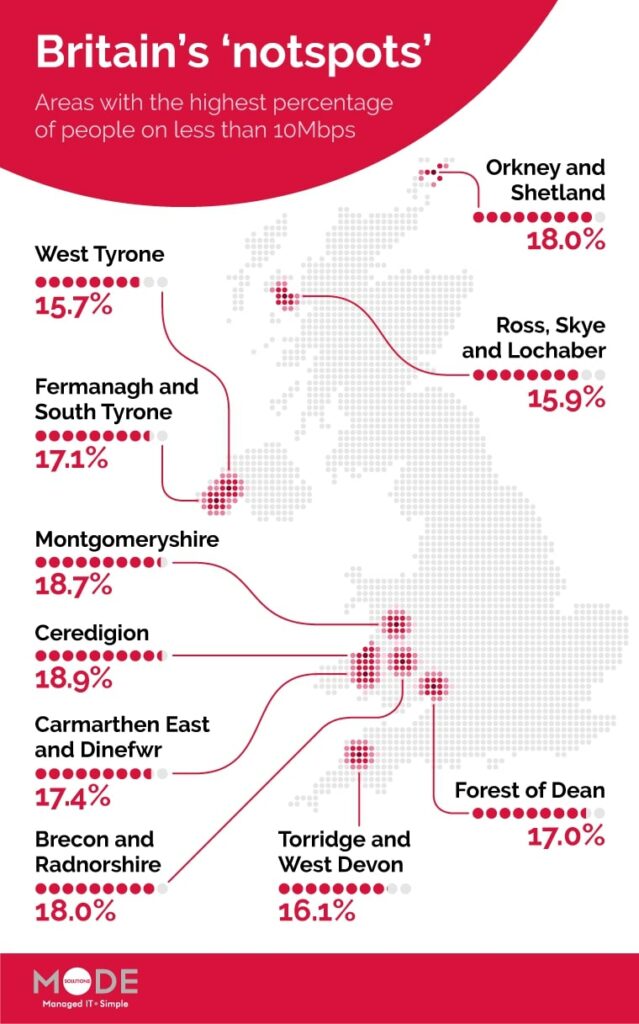
When we look at the location of Britain’s so-called ‘notspots’ – that is, places where usable broadband is hardest to access – we can see that they tend to be in places where the average speed is lower. This is true of the top three: Ceredigion and Montgomeryshire in Wales, and Orkney and Shetland in northern Scotland. Driving this are the various financial, logistical and ecological complexities of developing broadband infrastructure in hard-to-reach spots within these areas.
Will government action save the day?
In March 2021, the UK Government announced its £5bn ‘Project Gigabit’, commiting to deliver next-generation broadband to more than a million hard-to-reach homes. Cambridgeshire, Cornwall, Cumbria, Dorset, Durham, Essex, Northumberland, South Tyneside and Tees Valley are tabled as the first areas to benefit, with 510,000 homes in these locations set to receive speeds of 1000 Mbps – or one Gigabit. Work started in these locations in the first half of 2022. Norfolk, Shropshire, Suffolk, Worcestershire, Hampshire and the Isle of Wight are next in line to benefit.
However, the government has stated that Project Gigabit won’t cover the whole of the UK, with certain remote locations not considered a viable choice for new internet infrastructure. The solution could lie in “new wireless equipment, low orbit satellites or high-altitude platforms to beam faster connections to far-flung homes and businesses” – but this is not within the scope of the scheme. There is also potential for 5G to pick up the slack – although this is a way off. Leading provider EE recently announced that whilst their network covers over half of the UK, it won’t be until 2028 that the entirety of the UK has 5G access.
If you live in a remote location, these words will not offer much hope. And given how difficult it is for individuals and businesses to move from one part of the country to another, disparities in broadband access are becoming a cause of inequality and inefficiency that is hard to ignore. For the digital transformation of the UK to go from dream to reality, this pressing issue must be addressed.
About Espria
In a world permanently altered by COVID-19, Espria provides the crucial hybrid and remote working solutions that enable workforces to collaborate effectively and securely.
Our aim is to make things simple. Simple to understand, simple to manage – a business operation that’s seamless and hassle free. We focus on delivering outstanding services that are also future-proofed. With the right tools, your teams can operate at maximum efficiency whether they’re in the office or working from home.
Additionally, our recent acquisition of IT managed services provider eacs has extended Espria’s geographical reach, helping us provide our full suite of integrated solutions to businesses across the nation. We don’t think location should be an impediment to having top-notch IT systems.
To learn more about Espria or get a quote, contact us today.
Subsribe for updates and our latest research
You may be interested in

Beyond Copilots: Why AI Agents Are the Next Competitive Advantage
AI is no longer a tactical tool, it’s becoming the engine of enterprise transformation. While copilots and other generative AI tools have helped teams work faster, the real breakthrough is happening with AI agents: autonomous systems that don’t just assist but act, learn and orchestrate entire workflows across the business. The question every executive should be asking is: “How will we harness AI to create value at scale before our competitors do?” High-performing organisations aren’t waiting. They’re embedding AI agents into daily operations and seeing measurable impact; accelerated decision-making, leaner processes and stronger financial outcomes. When markets move at digital speed, standing still means falling behind. Here’s why: So, the question isn’t “Should we adopt AI?”, it’s “What could…

Zero Trust Networking
Protecting Employees Without Friction Your workforce is your greatest asset, and your greatest vulnerability. Attackers know this, which is why phishing and credential theft remain the most common entry points. But here’s the leadership challenge: how do you protect employees without slowing them down? Zero Trust answers that question by making security invisible yet uncompromising. Employees work from anywhere, home, client sites, airports, without clunky VPNs or endless password resets. Behind the scenes, every login is verified, every device assessed, every anomaly flagged. If something looks wrong, a compromised credential, an unusual location, the system reacts…

Shadow AI: Executive Briefing on Real Risks, Business Impact and Mitigation
Shadow AI is here, and it’s growing Shadow AI is the use of artificial intelligence tools and platforms outside the oversight of IT, security, or compliance teams. This is not a hypothetical concern. KPMG’s 2025 global survey found that up to 58% of employees are using AI productivity tools daily, and nearly half admit to uploading sensitive company information to unauthorised platforms. Only 41% of employees say their organisation has a policy guiding the use of generative AI, revealing a significant governance gap. The Risks Are Real and Substantial The evidence from leading analysts and recent incidents is clear:…

Cyber Resilience in 2025: From Tick-Box to Boardroom Imperative
What the NCSC’s 2025 Review Means for UK Businesses The National Cyber Security Centre’s (NCSC) 2025 Annual Review is a wake-up call for business leaders across the UK. The days when cyber security was simply an IT concern or a routine compliance task are over. With a record number of nationally significant cyber incidents handled in the past year (more than double the previous year’s figure), it is clear that cyber risks have become a central issue for organisational survival and national prosperity. The Evolving Threat: Why Businesses Can’t Afford Complacency No sector has been spared in the latest…

Is Your MSP Really Helping You Grow — Or Just Keeping the Lights On?
There’s a moment in every business where the question quietly surfaces: “Are we getting what we really need from our IT provider?” It’s not always easy to answer. On the surface, things seem fine. Tickets are resolved. Reports arrive. There’s someone to call when things go wrong. It’s familiar. It’s comfortable. And that comfort can be deceiving. Because beneath the surface, many organisations are stuck in a service relationship that feels safe — but is actually stagnant. And here’s the truth: comfort isn’t the same as progress. For many, the idea of changing MSPs or challenging the…
The 2025 State of Ransomware: Key Insights on Attacks, Costs, and Recovery
Ransomware continues to evolve — and so must our defenses. The State of Ransomware 2025 report from Sophos presents one of the most comprehensive views yet into how organisations around the world are being impacted by ransomware attacks. Based on an independent survey of 3,400 IT and cybersecurity leaders across 17 countries, the report explores how attacks are evolving, the operational weaknesses adversaries exploit, and the human and financial tolls that follow. Whether you’re building a cybersecurity strategy or assessing risk, this year’s findings offer crucial, real-world insights to guide your response. Key Findings from…