


Beyond Copilots: Why AI Agents Are the Next Competitive Advantage
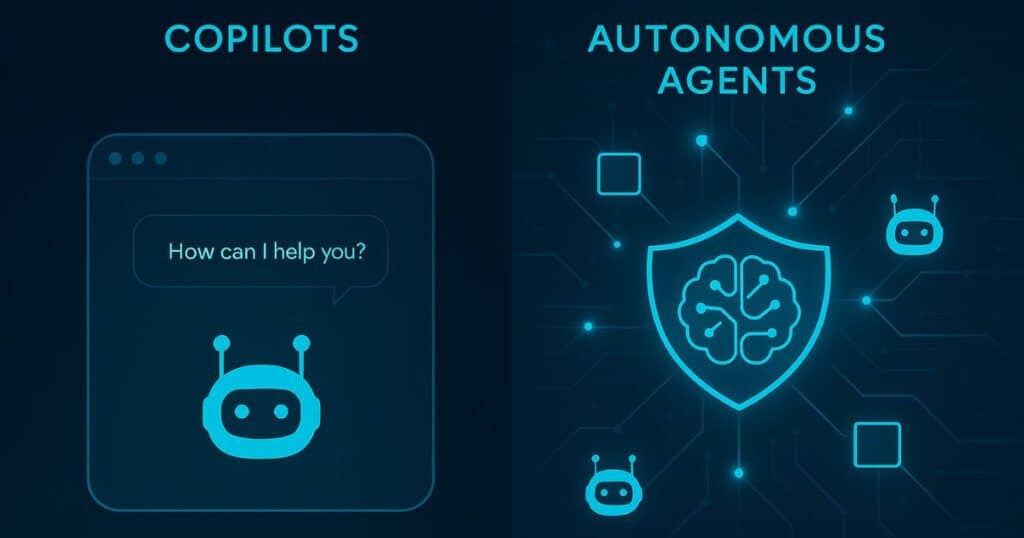
AI is no longer a tactical tool, it’s becoming the engine of enterprise transformation. While copilots and other generative AI tools have helped teams work faster, the real breakthrough is happening with AI agents: autonomous systems that don’t just assist but act, learn and orchestrate entire workflows across the business.
The question every executive should be asking is:
“How will we harness AI to create value at scale before our competitors do?”
High-performing organisations aren’t waiting. They’re embedding AI agents into daily operations and seeing measurable impact; accelerated decision-making, leaner processes and stronger financial outcomes.
When markets move at digital speed, standing still means falling behind. Here’s why:
- The economics of performance are being rewritten. AI agents don’t just cut costs, they unlock new revenue streams, compress cycle times and enable hyper-personalisation at scale. Competitors who operationalise AI first will set new benchmarks for speed and customer experience.
- Shareholder expectations are rising. Investors are rewarding companies that demonstrate AI-driven efficiency and growth. Delays signal indecision, which erodes confidence and valuation.
- Risk is compounding, not static. Regulatory complexity, supply chain volatility and cyber threats demand predictive capabilities. AI agents don’t just react, they anticipate and mitigate before impact. Without them, resilience becomes fragile.
- Talent and culture are shifting. High-performing employees expect intelligent tools that remove friction and amplify impact. Organisations that fail to deliver risk losing their best people to more progressive competitors.
So, the question isn’t “Should we adopt AI?”, it’s “What could our business achieve if we reimagined work with AI agents at the core?”
From Assistants to Autonomous Agents: A Cultural Shift
Copilots are reactive, they wait for prompts. AI agents are proactive, they plan, execute and adapt without constant human intervention. This shift isn’t just technological, it’s cultural. It challenges the very way we think about work, accountability and value creation.
What could our business achieve if we reimagined work with AI agents at the core?
It could mean transforming the operating model from incremental efficiency to exponential impact:
- Liberating human potential. By automating repetitive, low-value tasks, teams can focus on creativity, strategic decision-making and building relationship; the work that drives growth and differentiation.
- Redefining leadership. Moving from “command and control” to “orchestrate and empower”; where leaders set vision and priorities and AI executes at scale with precision and speed.
- Creating adaptive organisations. AI agents learn and improve continuously, enabling businesses to pivot faster than competitors in volatile markets.
- Building trust in autonomy. Success depends on governance and transparency. High-performing organisations embed accountability frameworks, so humans remain in control while AI amplifies capability.
This is not about replacing people, it’s about augmenting human intelligence with machine intelligence. The future of work is human + AI, working in synergy to deliver outcomes neither could achieve alone; faster innovation, sharper insights and a level of agility that manual processes simply cannot match.
The Leadership Imperative: Act Now
The question for every executive is no longer “Should we adopt AI?”, it’s “How fast can we operationalise AI to create measurable business value?” The window for competitive advantage is closing, and leaders who hesitate risk being disrupted. not in years, but in quarters.
Start with an AI Readiness Assessment
Before deploying agents, understand where your organisation stands. Assess:
- Data maturity. Do you have clean, connected data to fuel intelligent automation?
- Process complexity. Which workflows deliver the highest ROI if automated?
- Cultural readiness. Are your teams prepared for a shift from manual execution to AI-enabled orchestration?
This isn’t a checkbox exercise. it’s the foundation for scaling AI responsibly and effectively.
Then, Build Your AI Agent Pipeline
Once readiness is clear, move decisively to design and deploy AI agents where they deliver the greatest impact:
- Customer-facing agents for hyper-personalised engagement and faster service resolution.
- Revenue-driving agents that optimise pricing, forecast demand, and accelerate deal cycles.
- Risk and compliance agents that monitor transactions, flag anomalies and ensure regulatory adherence in real time.
Think of this as a strategic roadmap, not a tech project. Each agent should align with a business goal; growth, efficiency, resilience, and integrate into your operating model, not sit on the sidelines as an experiment.
Why now? Because the organisations that lead this transformation will set the performance benchmarks others struggle to match. AI agents aren’t a future trend, they’re the next competitive advantage.
Written by Steve Cook
You may be interested in

Zero Trust Networking
Protecting Employees Without Friction Your workforce is your greatest asset, and your greatest vulnerability. Attackers know this, which is why phishing and credential theft remain the most common entry points. But here’s the leadership challenge: how do you protect employees without slowing them down? Zero Trust answers that question by making security invisible yet uncompromising. Employees work from anywhere, home, client sites, airports, without clunky VPNs or endless password resets. Behind the scenes, every login is verified, every device assessed, every anomaly flagged. If something looks wrong, a compromised credential, an unusual location, the system reacts…

Shadow AI: Executive Briefing on Real Risks, Business Impact and Mitigation
Shadow AI is here, and it’s growing Shadow AI is the use of artificial intelligence tools and platforms outside the oversight of IT, security, or compliance teams. This is not a hypothetical concern. KPMG’s 2025 global survey found that up to 58% of employees are using AI productivity tools daily, and nearly half admit to uploading sensitive company information to unauthorised platforms. Only 41% of employees say their organisation has a policy guiding the use of generative AI, revealing a significant governance gap. The Risks Are Real and Substantial The evidence from leading analysts and recent incidents is clear:…

Cyber Resilience in 2025: From Tick-Box to Boardroom Imperative
What the NCSC’s 2025 Review Means for UK Businesses The National Cyber Security Centre’s (NCSC) 2025 Annual Review is a wake-up call for business leaders across the UK. The days when cyber security was simply an IT concern or a routine compliance task are over. With a record number of nationally significant cyber incidents handled in the past year (more than double the previous year’s figure), it is clear that cyber risks have become a central issue for organisational survival and national prosperity. The Evolving Threat: Why Businesses Can’t Afford Complacency No sector has been spared in the latest…

Is Your MSP Really Helping You Grow — Or Just Keeping the Lights On?
There’s a moment in every business where the question quietly surfaces: “Are we getting what we really need from our IT provider?” It’s not always easy to answer. On the surface, things seem fine. Tickets are resolved. Reports arrive. There’s someone to call when things go wrong. It’s familiar. It’s comfortable. And that comfort can be deceiving. Because beneath the surface, many organisations are stuck in a service relationship that feels safe — but is actually stagnant. And here’s the truth: comfort isn’t the same as progress. For many, the idea of changing MSPs or challenging the…
The 2025 State of Ransomware: Key Insights on Attacks, Costs, and Recovery
Ransomware continues to evolve — and so must our defenses. The State of Ransomware 2025 report from Sophos presents one of the most comprehensive views yet into how organisations around the world are being impacted by ransomware attacks. Based on an independent survey of 3,400 IT and cybersecurity leaders across 17 countries, the report explores how attacks are evolving, the operational weaknesses adversaries exploit, and the human and financial tolls that follow. Whether you’re building a cybersecurity strategy or assessing risk, this year’s findings offer crucial, real-world insights to guide your response. Key Findings from…

Outgrowing your MSP; businesses need a provider that scales with their growth
To stay competitive, business leaders must align with MSPs that deliver strategic value, drive innovation, and support to scale. Now firmly into 2025, it’s becoming clear what the year has in store for the IT landscape. For SMBs, the message is clear: business growth must be matched with smarter, more scalable managed services. The demand for cyber-resilient, cloud-first and AI-integrated solutions is no longer a forecast – it’s a reality already shaping business priorities. According to leading global technology market analyst firm Canalys’ MSP Trends 2025 report, the MSP model is transforming under growing pressure…