


Businesses are losing money and jeopardising security to IT sprawl and quick fixes, says Espria

IT Leaders must take action on unchecked technology sprawl and shadow IT that are draining budgets, increasing cyber risks, and complicating their digital environment.
According to a recent study, budgets towards insider risk management have doubled in the past 12 months, with 81% of business leaders looking to secure their internal business infrastructure as geopolitical tensions escalate and remote workforces become the norm.
‘Digital transformation ushered in new possibilities and solutions for computing, but it also introduced a potential for sprawl that burdens IT teams everywhere,’ said Brian Sibley, Virtual CTO at Espria.
‘When faced with an urgent problem, it’s only natural to install quick-fix tools to manage the situation and catch up with competitors, but without considering the long-term effects, this can snowball into an IT landscape that becomes progressively difficult to manage.
‘Without full visibility of every application in their infrastructure, organisations are exposed to cyber risks and potential compliance violations. Now burdened with growing time and security demands, IT teams are tackling shadow IT risks and unused tools that drain resources.’
The shifting political landscapes will bring further cyber inequity and with the predicted UK economic turbulence for 2025, Sibley believes that organisations must simplify their core IT stack now to become resilient against future troubles.
Sibley continued, ‘While businesses cannot control the political climate, IT leaders can control the cyber resilience of their infrastructure, and this begins with a thorough clean-up of the digital environment. A bloated tech stack and sprawling IT landscape will lead to a lack of oversight that allows malware to sneak in through unpatched vulnerabilities linked to unapproved apps and dormant systems no longer in use.
‘Not to mention, the advancements in AI that have broadened the scope and capabilities of cyber threats, enabling more sophisticated and automated attacks. To get ahead of any changing market demands and downturns, businesses should organise, optimise and update their IT infrastructure to remain agile and resilient.
Sibley goes on to describe the benefits of cutting and consolidating technology to reduce costs as well as retrofitting with new solutions that fit the business structure.
‘Areas of IT overlap and accumulation of unidentified tools must be addressed by leaders to eliminate potential vulnerabilities from unpatched software. Instead of overbuying products that overwhelm admins and wastes budget, proactive cost cutting and technology consolidation will contribute to a more resilient infrastructure.
‘Working with a managed service provider can help businesses evaluate any redundant software, optimise licensing fees and identify out-of-date hardware. By conducting a thorough assessment of systems, businesses can then identify the essential systems, implement the best fit solutions, and take the necessary steps to consolidate redundant or unnecessary tools.
‘After reducing tech bloat, teams can improve visibility across systems, allowing for better resource allocation and faster troubleshooting. IT leaders are also in a better cash position to invest in the future path to help the business grow.’
Sibley concluded, ‘Unchecked IT infrastructure can undermine the business’s security and financial posture and prevents the development of the kind of adaptability required to meet evolving economic challenges/times.
‘Without clear visibility of your infrastructure, organisations are leaving gaping holes that must be addressed to avoid serious liabilities such as compliance risks, reputational damage if there’s a breach, and costly security remediation and investment. Solving IT sprawl and shadow IT is a critical step toward a secure and scalable technology foundation. The healthier your business environment is today, the more resilient you will be in a downturn.’
You may be interested in
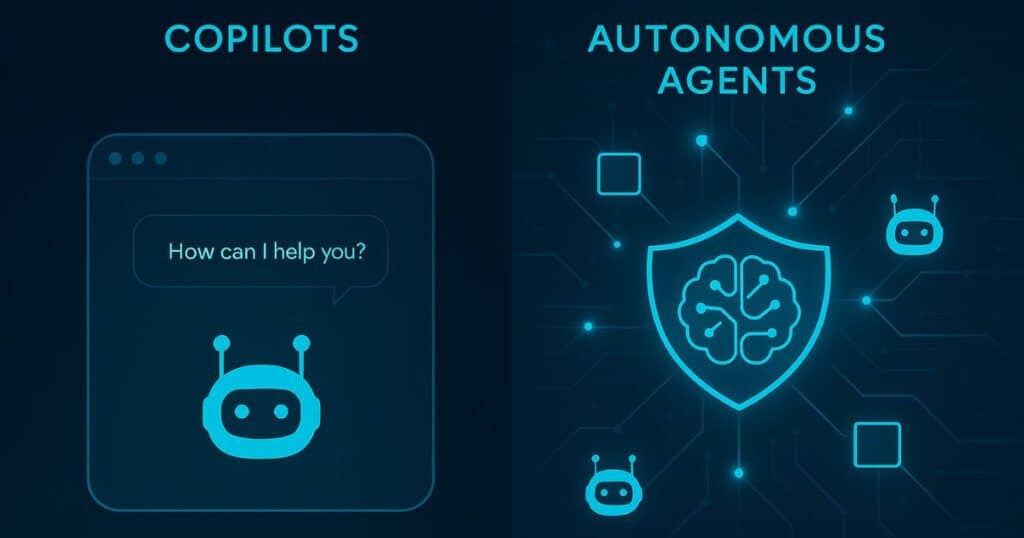
Beyond Copilots: Why AI Agents Are the Next Competitive Advantage
AI is no longer a tactical tool, it’s becoming the engine of enterprise transformation. While copilots and other generative AI tools have helped teams work faster, the real breakthrough is happening with AI agents: autonomous systems that don’t just assist but act, learn and orchestrate entire workflows across the business. The question every executive should be asking is: “How will we harness AI to create value at scale before our competitors do?” High-performing organisations aren’t waiting. They’re embedding AI agents into daily operations and seeing measurable impact; accelerated decision-making, leaner processes and stronger financial outcomes. When markets move at digital speed, standing still means falling behind. Here’s why: So, the question isn’t “Should we adopt AI?”, it’s “What could…
Zero Trust Networking
Protecting Employees Without Friction Your workforce is your greatest asset, and your greatest vulnerability. Attackers know this, which is why phishing and credential theft remain the most common entry points. But here’s the leadership challenge: how do you protect employees without slowing them down? Zero Trust answers that question by making security invisible yet uncompromising. Employees work from anywhere, home, client sites, airports, without clunky VPNs or endless password resets. Behind the scenes, every login is verified, every device assessed, every anomaly flagged. If something looks wrong, a compromised credential, an unusual location, the system reacts…

Shadow AI: Executive Briefing on Real Risks, Business Impact and Mitigation
Shadow AI is here, and it’s growing Shadow AI is the use of artificial intelligence tools and platforms outside the oversight of IT, security, or compliance teams. This is not a hypothetical concern. KPMG’s 2025 global survey found that up to 58% of employees are using AI productivity tools daily, and nearly half admit to uploading sensitive company information to unauthorised platforms. Only 41% of employees say their organisation has a policy guiding the use of generative AI, revealing a significant governance gap. The Risks Are Real and Substantial The evidence from leading analysts and recent incidents is clear:…

Cyber Resilience in 2025: From Tick-Box to Boardroom Imperative
What the NCSC’s 2025 Review Means for UK Businesses The National Cyber Security Centre’s (NCSC) 2025 Annual Review is a wake-up call for business leaders across the UK. The days when cyber security was simply an IT concern or a routine compliance task are over. With a record number of nationally significant cyber incidents handled in the past year (more than double the previous year’s figure), it is clear that cyber risks have become a central issue for organisational survival and national prosperity. The Evolving Threat: Why Businesses Can’t Afford Complacency No sector has been spared in the latest…

Is Your MSP Really Helping You Grow — Or Just Keeping the Lights On?
There’s a moment in every business where the question quietly surfaces: “Are we getting what we really need from our IT provider?” It’s not always easy to answer. On the surface, things seem fine. Tickets are resolved. Reports arrive. There’s someone to call when things go wrong. It’s familiar. It’s comfortable. And that comfort can be deceiving. Because beneath the surface, many organisations are stuck in a service relationship that feels safe — but is actually stagnant. And here’s the truth: comfort isn’t the same as progress. For many, the idea of changing MSPs or challenging the…
The 2025 State of Ransomware: Key Insights on Attacks, Costs, and Recovery
Ransomware continues to evolve — and so must our defenses. The State of Ransomware 2025 report from Sophos presents one of the most comprehensive views yet into how organisations around the world are being impacted by ransomware attacks. Based on an independent survey of 3,400 IT and cybersecurity leaders across 17 countries, the report explores how attacks are evolving, the operational weaknesses adversaries exploit, and the human and financial tolls that follow. Whether you’re building a cybersecurity strategy or assessing risk, this year’s findings offer crucial, real-world insights to guide your response. Key Findings from…